Content Hangover No. 8 by: Garrett Crusan
The Joyful Noise of the Sun Ra Arkestra
On a searing day in 2022, I unknowingly attended a birthday party that quickly became a ritual of sorts. The soundtrack of the party summoned an unprecedented downpour of rain out of a perfectly clear blue sky. Friends brought out a cake with candles, the thunderstorm subsided.
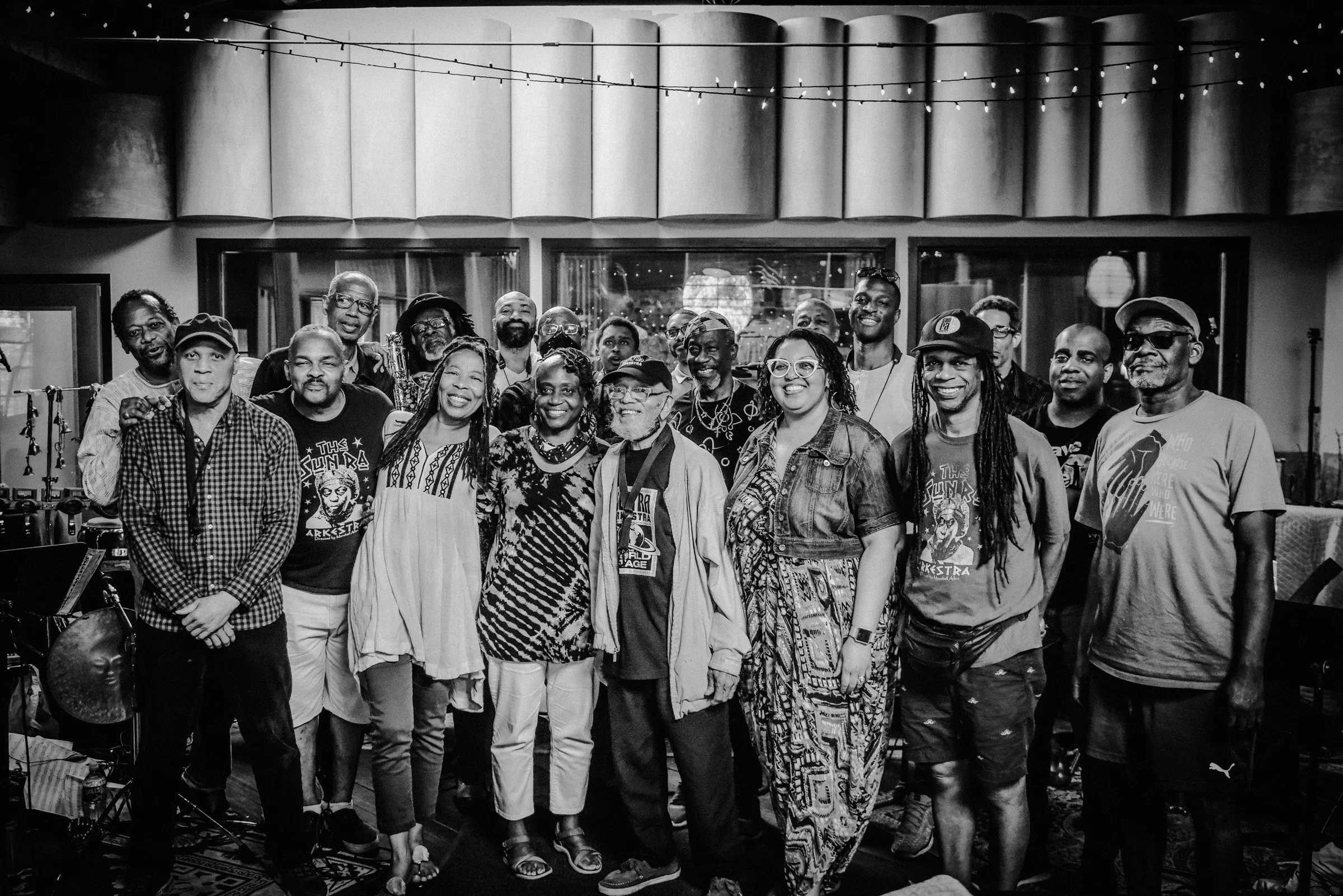
It was the 98th birthday of Marshall Allen, one of the most anomalous avant-garde jazz legends. The celebration took place during a particularly affecting performance from the Sun Ra Arkestra. Allen only spoke through his saxophone during this performance, flicking his right hand against the keys of the horn resulting in conversational yips and shouts—he’d do the same when taking a solo, except more frequently and insistently. Like many of the experimental greats, his disregard for tonality led him somewhere deeper and more complicated in musical conversation, and the band followed suit. It’s a specific level of improvisation that only few players can (or could ever) reach, and one that can’t be truly imitated, despite any given musician’s best efforts. There’s a very fine line between simple atonality and what Ra called the “joyful noise” that’s tough to cross, and, behind a wailing horn, Allen was beyond joyful that day.
I’ve only ever seen indie rock shows full of hipsters and quietly rich 20-30-somethings at TV Eye in Ridgewood. Because of this, there was a natural environmental dissonance when I stopped by the venue to see the Arkestra for a second time; the clientele combined with the venue’s name being a reference to a song by a man who once hurled racial epithets at a black concertgoer in order to goad him into stabbing him seemed antithetical to the Arkestra somehow. Can you summon a thunderstorm from the confines of a windowless room?
I was about an hour early, so I wandered outside to the patio for a smoke and sat down to watch Jeopardy on the outdoor projector. The usual patrons parked at the perimeter benches and fought for shade under the picnic table umbrellas. I was so engulfed by the predictability of this scene that I barely noticed Marshall Allen and tenor saxophonist Knoel Scott sauntering out to the patio to watch Jeopardy with everybody else just a few feet away from me.
Allen, at a spry 102 years old, was carefully lighting up a Black & Mild to my left, as if he were any other showgoer smoking outside. Scott joined him in alternating puffs as they talked about hitting the road after the show, wherever they were off to next. Allen often just smiled and nodded in quiet agreement. I began to wonder whether Black & Milds might be the well-kept secret to Allen’s cosmic longevity—even the leader of the space-age Arkestra needs something to bind him to Earth.
Throughout the years of examining the history of jazz (as well as Ra and the Arkestra) to an almost forensic extent, I’ve sometimes found myself on the edge of the slippery slope of making myths of normal (and sometimes problematic) players. It’s easy to falsely iconize the greats if you’ve read a book like Miles, or heard the lore of Monk through teachers three-decades removed. Ra, however, is impossible not to make myth because he is somewhat of a living myth by trade. This is due in part to Ra’s complicated and scattered history: most notably, he claimed to have visited Saturn in the late 30s, earlier than all public accounts of UFOs or alien abductions. The timeline of his life warped and shuffled around based on different accounts and conversations with him. Jazz historian and biographer John Szwed did his due diligence in attempting to piece together his life, but when records are skewed, only the corners of the puzzle can ever get solved.
After his passing in 1993, the myth of Ra was transferred to Allen, who took over leading the Arkestra in 1995. He is described by Szwed as “Ra’s most loyal disciple” and by Knoel Scott as “the cosmically delegated leader of the Sun Ra Arkestra.” The first time I saw Allen perform on his 98th birthday, he was still a myth to me; however, seeing him five feet away from me, smoking against the perimeter of a venue I’ve been to a dozen times, turned him, for a moment, into a human.
I’d never seen a live setup at TV Eye that was quite like the Arkestra’s. Dozens of chairs packed the stage with disheveled piles of assorted charts scattered underneath; the Arkestra’s trademark sequins and vibrant purples, blues, and yellows draped the stage’s backdrop. A woman next to me with oversized glasses and a gauged septum piercing stretched her arms and legs as she waited, fully adhering to the Arkestra dress code in a vivid multi-colored dress. A majority of the other audience members seemed reluctant to stretch out their legs and stood tensely, gripping the remains of their drinks in stiff anticipation. A shorter woman weasled her way to the front with me and, like the woman with the septum piercing, was shaking out her arms and legs, gently two-stepping to warm up her body for the show. I figured at this point that I was in for more dancing than I bargained for, and once the Arkestra took the stage, I realized that I was right.
Under Allen’s direction, the Sun Ra Arkestra stuck to the avant-big-band roots of Ra’s classic work, besides one composition by Allen, “Swirlin’”. In this way, the Arkestra is (for lack of a better term) a kind of tribute band, but one that carries on the legacy of its founder and channels his energy as if he were present on stage with them, calling him out by name in songs of praise, beckoning him to come back from Saturn and bless the room we were in.
The ensemble has a way of harnessing the infinite present moment and amplifying it to an absolutely unprecedented degree. Their performance was a single moment full of moments, one that blurs the line between audience and performer so drastically that it’s impossible not to feel as if you’ve become a part of the Arkestra itself simply by attending. Percussionists came down from the stage and draped audience members in their robes, placing cowbells over their heads and pulsing away, forcing even the meekest to move and be engulfed in the sound in a physical way under the safety of sheer fabric. Horn players and percussionists marched proudly through the audience. Allen’s solos were urgent, atonal speeches about love, perseverance, and transcendence. I don’t dance, but I found myself moving harshly with everyone around me, shedding a few strange, inexplicable tears—a natural aftermath of witnessing a truly joyful noise. How do you describe a single moment?
The show was over as quickly as it started. Once the ensemble exited the stage to the tune of “We Travel the Spaceways,” hugs were shared among strangers, bodies kept moving. We had all shared something truly singular and extraterrestrial. In lieu of shouts for an encore, some audience members simply chanted Ra’s legendary mantra: “Space is the place.”
I stepped outside, directly following Knoel Scott and eyeing the Black & Mild in his hand. Like cosmic clockwork, it started to rain.