Content Hangover No. 4 by: Garrett Crusan
Against The Reduction of Ratboys
Warsaw Brooklyn 03.04.26
Almost exactly ten years ago, I saw the Chicago indie outfit Ratboys for the first time in Pittsburgh. I was there to see the now-defunct emo maximalists in Sorority Noise, oblivious to the remainder of the bill—but I remember laughing innocently at the name ‘Ratboys’ when frontwoman Julia Steiner first introduced the band. “These guys seem nice.”
For the first time in my life (only 15 years of it at that point), I found myself in that blissful surprise of connecting more with an opening act than I did with the group I had intended to see. Sorority Noise’s Cam Boucher had a disposition for post-emo song structures that always inevitably led to an explosion of noise, grief, and heartache; no matter how much turmoil is welling up inside any given audience member, at a certain point, emotional bandwidth starts to wear thin. Boucher was often so removed from the audience that even the sentiment (or excuse) of “music as therapy for both performer and audience” was completely fraught by the time his 40 minutes were up. Sorority Noise was a classic example of the mid-2010s emotional trauma-dumper frontman conundrum, a band that was problematically teleological in its expressions of grief and loss hidden under the guise of PR descriptors like “devastating” or “emotional” or “intense.”
Ratboys stood out a mile on that bill. In 2016, their brand of Midwest indie was—at least on the surface—brighter, more energetic, and more fit for chilling out and smoking a joint inside the venue. They could, however, easily reach the same poignant emotional depth as Sorority Noise while slashing the decibel count in half (and nixing the on-stage freak-out jerk-off completely). I recall chatting with Steiner at the merch table before leaving. “These guys seem nice.”
____________
My honeymoon phase with Ratboys ended when I stopped sifting through the Topshelf Records website and decided to trade indie for jazz; a manic college-admissions based frenzy that was also abandoned almost instantaneously upon realizing that jerk-offish musical clientele were not just limited to the Pittsburgh indie rock scene. However, when Ratboys’ 2023 record The Windowwas released and the track “Morning Zoo” started materializing on everyone’s Discover Weekly playlists, I fell back in love with them all over again. The Window marked a shift in their sound towards the current craze of alt-country revival—or, at least, that’s what some major publications were making it out to be. That record, along with their newest (and best) project Singin’ To An Empty Chair,have country in the bloodstream, but it’s well below the legal limit. Ratboys still retained their roots in the Midwest emo/pop-punk sphere with tracks chock-full of anthemic hooks, raucous guitar solos, and half-step-down powerchords out the ass. However, if you touch that pedal steel even once, you might as well be Waxahatchee (with Katie Crutchfield being one of the first mainstream indie-to-country converts). It was a way to strike while the iron of fiddle and twang was red-hot.
A specific and popular review of The Window spends multiple paragraphs comparing the band to their alt-country contemporaries sonically and lyrically in a way that, even in a positive review, ultimately paints them as an extension of an already-existing scene rather than emphasizing an undeniable evolution of a band that’s been at it for nearly fifteen years. Its compliments are merely sonic cross-examinations of artists across decades—Breeders, Wednesday, Gin Blossoms, McCartney—but most damning of all is the painting of Ratboys as a “nice” band: “perennially likable Chicago group;” “a band that had always seemed perfectly content playing club shows;” “fundamental humility that was always so key to the group’s appeal;” “What a pleasure it is hearing this charming little band show off.”
That final comment, one that Steiner has openly called a “backhanded compliment,” seemed to spark what became the ultimate press descriptor for the Chicago group: “nice.” Other publications followed the money—“likable the way your mailman is likable” is one of the more heinous violations—and Ratboys became the nice, rootsy indie band on the sidelines, one whose Apple Music blurb on their most recent record begins with, “It feels like it could be right at home on a Wednesday or Waxahatchee album!”
I was hard-pressed for answers. How provoking must it be to have a breakthrough be reduced to scene affiliation, to watch writers bloating criticisms with low-hanging stylistic comparisons and painting a band just as emotionally affecting as their past and present contemporaries as simply “charming”?
____________
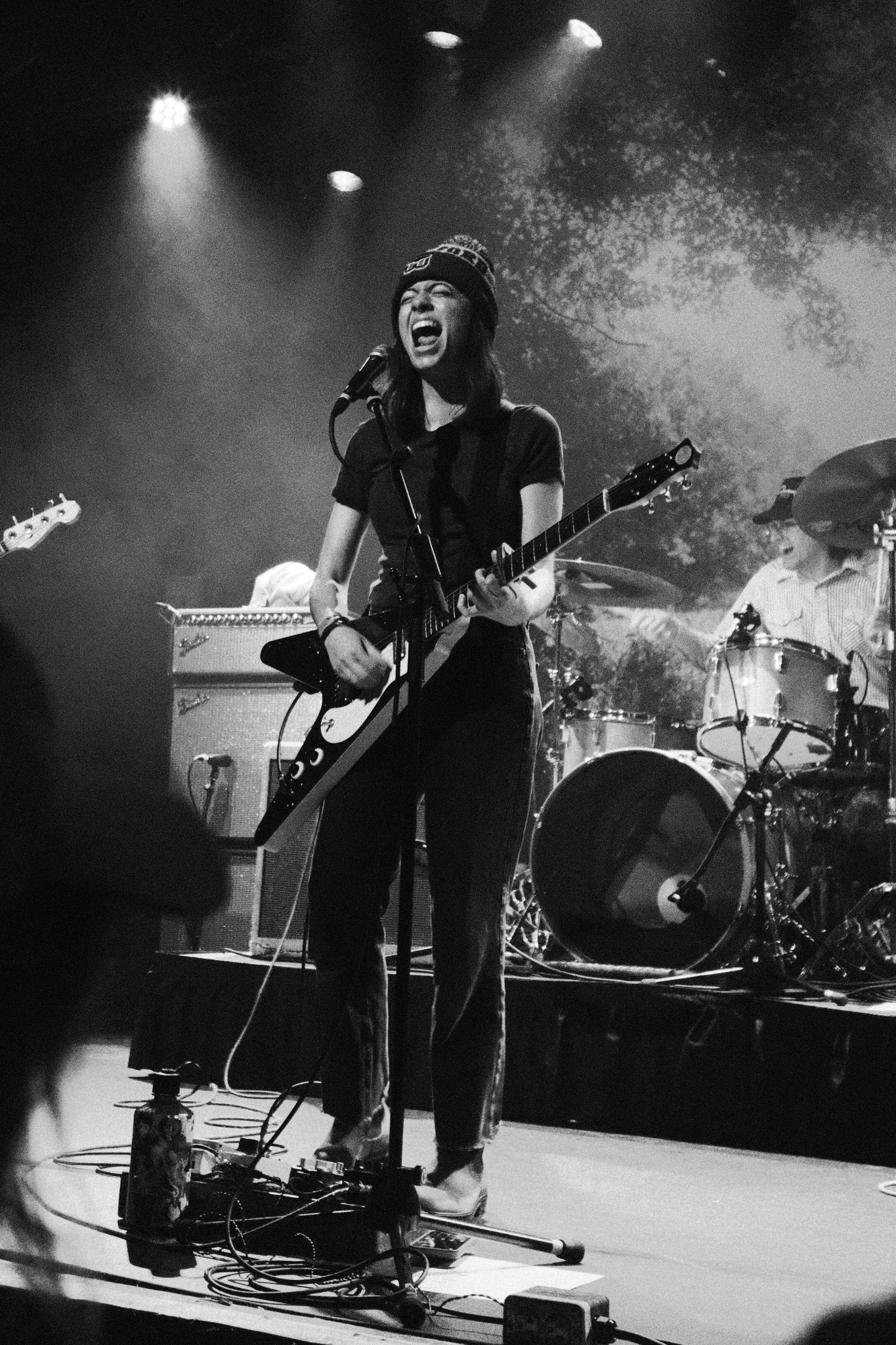
In an effort to wrap my head around this confounding wave of half-baked criticisms, I attended their most recent show at Warsaw in Brooklyn earlier this March. The room was six times the capacity of the space I saw them in ten years ago—the first overt sign of Ratboys’ ongoing success in their corner of the world.
Singin’ To An Empty Chair’s album art functioned as the stage’s massive backdrop: a lush forest scene with a large clearing in the middle, in which two empty wooden chairs faced each other directly. The album’s title and artwork alludes to Gestalt therapy and the “empty chair” method—speaking candidly to a vacant seat where an imagined lost loved one or part of oneself is sitting. This technique (and Steiner’s first experience in therapy) functioned as the crux of their newest project, so intensely that Steiner even considered mailing a copy of the record to the person it was directed towards. The tracks, like the cover’s art, are luxuriant and shimmery, even more so when performed live. However, despite the sheen on new set staples like “Open Up” or “Anywhere,” these songs all bleed with desperation. There’s an undeniable tenseness to the project, one that was amplified tenfold through performance and, in a roundabout way, celebrated.
Ratboys blew through nearly the entire record that night (besides its closing track, “At Peace In The Hundred Acre Wood,” a sort of emotional coda) along with some old classics with airtight fervidness. Steiner and company also welcomed the New York Alliance Against Racist And Political Repression to the stage to promote their urgent core agendas, invite the audience to their next few events, and encourage community action and organization within everyone’s respective neighborhoods. This preceded their last non-encore song in the set “Burn It Down,” a brooding, cacophonous 8-minute slow-burn that’s exactly what you think it’s about: the urge to dismantle the government systems that are destroying the working class and marginalized communities around the country by any means necessary. Is that what you’d call “nice”? Seems like an undercut to the revolutionary.
____________
When I was trekking home through the pouring rain, I realized that I was no less stumped than when I arrived. Sure, Ratboys were full of infectious energy, and the show itself was incredibly enjoyable; however, you can’t hear lines like “A couple some odd years ago / You said, ‘Sweetie take your time’/ So now I'm singin' to an empty chair / Bleedin' out every line” and not feel grief’s vice-grip secondhand—right?
When Sorority Noise were whining out despondent platitudes ten years ago (albeit more self-hating at times), they immediately had their PR and scene reputation written in stone as “intense”; “niceness” wasn’t even in the picture. The fact that Ratboys and Sorority Noise might have an overlapping lyrical or scene venn diagram (with the former being considerably more tactful in its expressions of complicated emotions) is proof that, for some reason, Ratboys aren’t often dissected below their sonic surface. Ratboys aren’t a “nice” band: they’re a nervous one, an explosive one, a lived-in, confused group of undeniable Chicago talent hunting for the answers of life’s toughest questions below the sparkle of their arrangements.
So, then: why is the conversation surrounding them just “nice”? Is it Steiner’s clean soprano? Is it their disposition towards anthem indie? Is it because they thanked the audio tech? And, most importantly: is that really all we have to say about Ratboys?