
Content Hangover No. 2 by: Garrett Crusan
What Cate Le Bon Is Made Of
Irving Plaza: 01.17.26
Photography by: H. Hawkline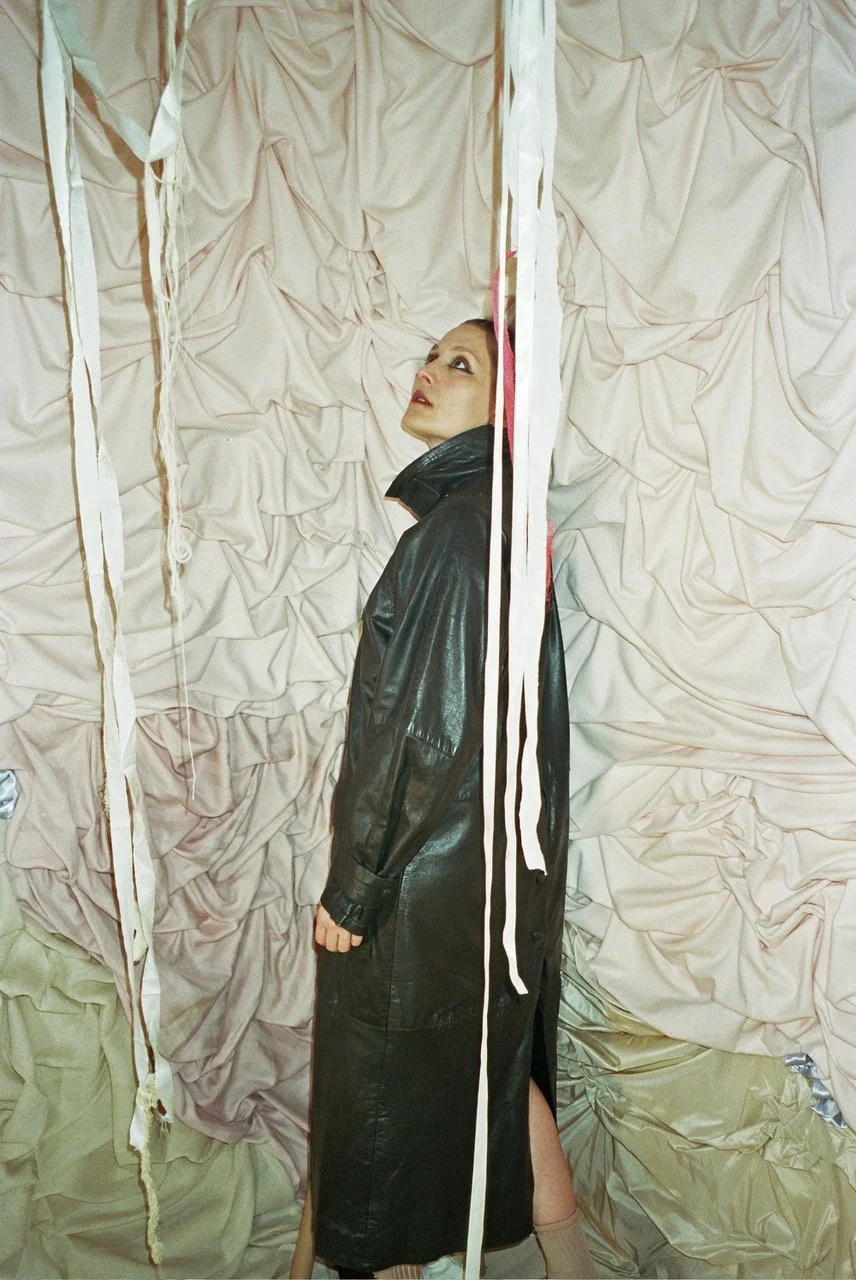
I wasn’t surprised to learn that Welsh artist Cate Le Bon once turned to furniture-making as a left-field effort to combat her musical burnout. Not as a DIY home-improvement architect, but rather a schooled and methodical woodworker, a statement-piece aficionado. Few, if any, can say they’ve crafted a companion-chair for an upcoming record besides Le Bon, an impressionistic Bauhaus throne for an artist who has carved out a notch in the music industry so idiosyncratic that it would be impossible for it to go unnoticed. The fabrication of this companion-chair functions as an apt physical metaphor to the world that Le Bon has constructed for herself in the past decade-and-change: an abstracted monolith, something familiar but uncanny, a futuristic seat that only she is fit to sit in.
Le Bon’s knack for craftsmanship is just one section in a lengthy resumé that sheds light on how she arrived at her very peculiar role in the world of contemporary music: session player; ceramicist; once joined Jon Cale during a London Symphony Orchestra performance; one half of the experimental music duo Drinks; strange and somewhat disparate parts. And, on top of seven acclaimed solo records, she has been metamorphosing over the past few years as a record producer with an unmistakable sonic footprint. The projects she has worked on (Wilco’s Cousin, Horsegirl’s Phonetics On And On, and, most recently, Dry Cleaning’s Secret Love, on top of many others) all proudly embody what has become the “Le Bon” sound; a producer’s chair Midas-touch that transfigures once-grounded compositions into art-rock universes just close enough to the listener that they can just barely graze their fingers over them.
A piece of printer paper was lazily scotch-taped to the wall separating the two coat-check windows at Irving Plaza: “The artist kindly asks that no photos or video are taken during the performance. Live in the moment!” or something along those lines. People were silently gawking and pointing towards the signage as if it were a sleeping alien. Music For Airports was funnelling through the lobby’s house speakers, floating just above the surface of the eager bar-line chatter. I drifted into the standing room, heading immediately towards the balcony. From above, the main ballroom resembled the idea of a “grand” place—chandeliers, a massive disco ball, red velvet curtains overlaying the walls—but something about the scene was fragile, like I could reach out with a single hand and break it all apart like a saltine cracker. The audience was an amalgamation of in-betweeners: in-between scenes, tastes, fashions, sexualities, this or that.
I was taking note of these things and shuffling back down the stairs to secure a spot on the floor when I spotted a man tucked away in a corner, leaning on the curtain-wall, white-knuckling a thick novel with a bold yellow cover. Surely, I thought, he’d put it down once Frances Chang took the stage, but somehow even her unique blend of solo-piano avant-garde mysticism couldn’t hold him as spellbound as his book did. Fog rolled over the stage and trapped itself inside the tightly focused cones of light from the spotlights above Chang, turning over endlessly. Behind me, two audience members began to bicker back and forth about the difference between metaphor and allegory, raising their voices to fill the gaps between songs. Meanwhile, shards of Chang were pouring out of the venue speakers, all digitized into kaleidoscopic backing tracks. I was shocked to find that the people around me had no interest in picking them up.
If there’s anywhere that hypermasculine chest-puffing is unwelcome to rear its ugly, balding head, it’s in the standing room of a Cate Le Bon show. This sentiment flew over the head of a man standing a couple rows in front of me who, in between sets, gradually slipped into a half-assed push-and-shove with another audience member. From what I could gather of the situation, the instigator (a disheveled tech-bro in his mid-thirties) decided that he’d attempt to impress the woman he showed up with by asserting his dominance over a more meek character standing directly behind them who would occasionally brush into their backs or elbows in the packed crowd. The match of the century: Silicon Valley’s he-man on a second date versus the shy short guy in a green knit sweater. When the he-man began to raise his voice and the shoving became more aggressive, the meek man’s crew of respectful in-betweeners broke up the fight. One of them held their startled friend by the shoulders, massaging him like a boxing coach. The men were separated, connecting only through cross-eyed one-way glances from the he-man, who retained his spot closer to the stage.
Like clockwork at the cool-down of the fight, the lights dimmed and lyrics from Ivor Cutler and Linda Hirst’s “Women of the World” proclaimed: “Women of the world, take over / Because if you don’t, the world will come to an end / And we haven’t got long / Men have had their shot / Look at what we’ve got.” Cate Le Bon and her collection of multi-instrumentalists arrived casually, as if no one except for the Silicon Valley he-man was in the audience. Sheer pink fabric was gently draped over their instruments and microphone stands; intentional or not, I couldn’t help but smile at that detail, a delicate counterpoint to Steven Tyler’s legendarily drug-laced microphone scarves. This, paired with Cutler’s track as a walk-on (also seemingly a counterpoint to Tyler and Aerosmith’s pining, macho jerk-off rock in “Woman of the World”) was a perfect way to make a first appearance: without saying a word, Le Bon asserted to the he-man and those like him past-and-present: “You are not welcome here, and I do not make music for you.” Roaring applause. “Men have had their shot / Look at what we’ve got.”
Le Bon was clad in all white, save for a thick black belt that split her into two halves. Despite her craftsman’s history, there was no complex architecture dominating the stage; no post-modernist throne, no dramatic set pieces. The floor-to-ceiling pastel-pink curtain behind them was all that was necessary here, a hunk of fleshy velvet serving as a backdrop for the cast of musicians all nestled into their respective stations. The band alone was enough of a construction to showcase the side of Le Bon that is a builder. Each foundational member was equipped with a set of carefully curated instruments meant to do justice for Le Bon’s signature offbeat arrangements: a trio of vocalizations melting into keys and saxophone during “Moderation;” “Home To You” and its signature xylophone lead; dueling woodwinds in “Mother’s Mother’s Magazines;” eccentric hand-picked materials that, when combined, held each other’s weight and balanced perfectly on top of one another. A rock cairn; a stack of coins; a house, even.
For the duration of Le Bon’s seventeen-song set, it seemed like she was trying to not float away. In performance, she had a disposition towards the physical, using the body as a tool to anchor her to the stage—often, she’d pound her right fist against her heart or clap along in quarter notes when she wasn’t busy singing. She’d habitually use a single hand to shield her eyes; during “Heaven Is No Feeling,” she went so far as to utilize both hands to obscure her view of the audience entirely, looking straight up into the ceiling through the cracks between her fingers. The body, and the way it instinctively interacts with itself through music, was used as a vehicle for Le Bon to stay present in the midst of the surrealist diorama she was gluing together in front of us. While it easily could’ve slipped into this territory, the performance was not “the Cate Le Bon Show;” it was instead a showcase of a piece of her. Le Bon’s live show is just a single part of the machine that is her craft, a foundational staple that is strong enough to stand on its own entirely without need to study the blueprint of her career. To not study that blueprint, however, would be to not know Cate Le Bon.
During the performance, the meek man was silent and practically dead-still, turned completely to stone by the Medusa of hypermasculinity. During Le Bon’s haunting ballad “Is It Worth It (Happy Birthday),” he cried almost inaudibly: “No collateral joy / No favourite son / Just the lovе you gave / On the sideboard.”
Thanks to Matt Grimm of Pitch Perfect PR for having us. You can listen to Cate Le Bon’s new record “Michelangelo Dying” now.